What is the MBTI Framework?
The Myers-Briggs Type Indicator (MBTI) is one of the world’s most widely used personality frameworks. Developed by Katharine Cook Briggs and her daughter Isabel Briggs Myers, it’s based on Carl Jung’s theory of psychological types. The framework categorizes personalities along four dimensions, producing 16 distinct personality types. It’s one of several popular personality systems — others include the Enneagram, which focuses on core motivations rather than cognitive preferences.
While the MBTI has its critics in academic psychology, it remains a popular and useful tool for self-reflection, team building, and understanding interpersonal dynamics. Millions of people take MBTI-style assessments every year.
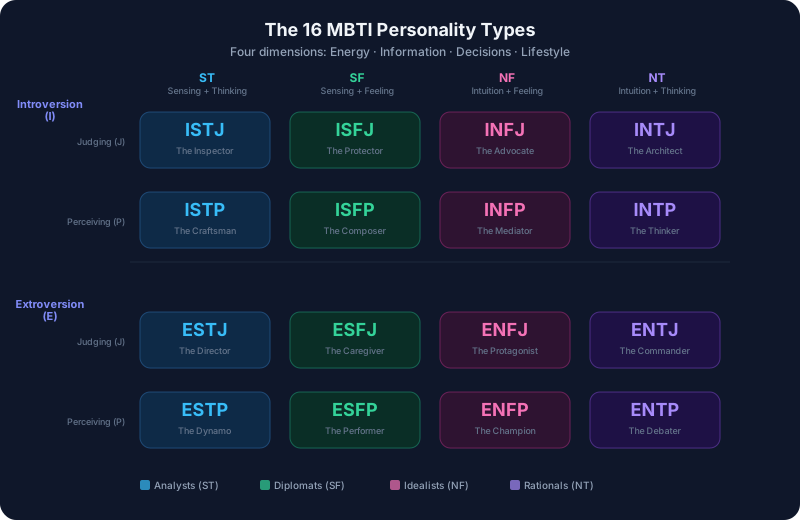
The Four Dimensions
Extraversion (E) vs. Introversion (I)
This dimension describes where you direct your energy:
- Extraverts gain energy from social interaction, tend to think out loud, and prefer action-oriented environments
- Introverts recharge through solitude, prefer to think before speaking, and often enjoy deep one-on-one conversations over group settings
This is not about being shy or outgoing — it’s about where you draw your mental energy from.
Sensing (S) vs. Intuition (N)
This dimension describes how you take in information:
- Sensors focus on concrete facts, details, and present realities. They trust what they can see, hear, and touch
- Intuitives focus on patterns, possibilities, and future potential. They enjoy abstract thinking and reading between the lines
Thinking (T) vs. Feeling (F)
This dimension describes how you make decisions:
- Thinkers prioritize logic, consistency, and objective analysis when making decisions
- Feelers prioritize values, harmony, and the impact of decisions on people
Both approaches are valid — Thinkers can be empathetic, and Feelers can be logical. The difference is which lens they naturally apply first.
Judging (J) vs. Perceiving (P)
This dimension describes how you approach the outside world:
- Judgers prefer structure, planning, and decisiveness. They like to have things settled and organized
- Perceivers prefer flexibility, spontaneity, and keeping options open. They adapt well to changing circumstances
The 16 Types
Analysts
INTJ — The Architect Strategic, independent thinkers with a natural talent for planning. INTJs see the big picture and work methodically toward their vision. They value competence and can be perfectionistic. Famous examples often cited include Elon Musk and Michelle Obama.
INTP — The Logician Innovative, curious minds driven by an insatiable thirst for knowledge. INTPs love exploring theories and finding logical inconsistencies. They can get so absorbed in thought that they lose track of practical matters.
ENTJ — The Commander Bold, decisive leaders who see inefficiency as a challenge to overcome. ENTJs naturally take charge and organize people toward goals. They’re direct communicators who value competence and results.
ENTP — The Debater Quick-witted, clever conversationalists who enjoy intellectual challenges. ENTPs love playing devil’s advocate and exploring ideas from every angle. They thrive on novelty and can become bored with routine.
Diplomats
INFJ — The Advocate Quietly idealistic, principled, and deeply caring. INFJs are driven by a strong sense of purpose and a desire to help others. They’re often described as the rarest personality type, making up about 1-2% of the population.
INFP — The Mediator Imaginative, empathetic idealists guided by strong inner values. INFPs seek authenticity and meaning in everything they do. They’re often creative and drawn to artistic expression.
ENFJ — The Protagonist Charismatic, natural leaders who inspire and motivate others. ENFJs are deeply attuned to people’s needs and feelings. They often find themselves in mentoring or counseling roles.
ENFP — The Campaigner Enthusiastic, creative, and sociable free spirits. ENFPs see life as full of possibilities and bring infectious energy to everything they do. They connect ideas and people in innovative ways.
Sentinels
ISTJ — The Logistician Practical, fact-oriented, and incredibly reliable. ISTJs value tradition, order, and responsibility. They form the backbone of many organizations with their dependable and thorough approach.
ISFJ — The Defender Warm, dedicated protectors who work behind the scenes. ISFJs are attentive to others’ needs and take their responsibilities seriously. They’re often the glue that holds groups together.
ESTJ — The Executive Organized, logical managers who excel at bringing order to chaos. ESTJs are clear about their values and stick to them. They lead by example and expect the same dedication from others.
ESFJ — The Consul Caring, sociable, and community-minded. ESFJs are attuned to others’ emotions and eager to help. They value harmony and often take on organizing roles in their social circles.
Explorers
ISTP — The Virtuoso Bold, practical experimenters who love to take things apart and figure out how they work. ISTPs are calm and collected, even in crisis situations. They learn best through hands-on experience.
ISFP — The Adventurer Gentle, sensitive artists who live in the moment. ISFPs express themselves through action rather than words. They value personal freedom and enjoy exploring new experiences.
ESTP — The Entrepreneur Energetic, perceptive people who thrive on action and immediate results. ESTPs are skilled at reading people and situations. They prefer to solve problems in real-time rather than plan ahead.
ESFP — The Entertainer Spontaneous, energetic, and fun-loving. ESFPs light up any room they enter. They live for shared experiences and have a natural talent for making others feel comfortable and engaged.
How to Use Your Type
Understanding your MBTI type can help in several areas:
Career Planning
Different types tend to thrive in different work environments. For example, ENTJs often excel in leadership positions, while ISFPs may prefer creative or hands-on roles. Use your type as one data point — not the sole factor — when exploring career paths.
Relationships
Understanding type differences can improve communication with partners, friends, and family. A Thinking type might learn to consider feelings before delivering criticism, while a Feeling type might learn to appreciate direct feedback.
Personal Growth
Your type highlights both strengths and growth areas. Introverts can practice stepping out of their comfort zone socially, while Extraverts can develop deeper self-reflection practices.
Team Dynamics
Diverse teams with multiple personality types often outperform homogeneous ones. Understanding type differences helps team members appreciate different working styles.
Common Misconceptions
- Types aren’t boxes: MBTI describes preferences, not rigid categories. Everyone uses all eight functions to some degree
- No type is better: Each type has unique strengths and challenges
- Types can develop: While core preferences tend to be stable, people can develop their less-preferred functions over time
- It’s not scientifically rigorous: Academic psychologists generally prefer the Big Five model, but MBTI remains useful for self-reflection
Take the Next Step
Curious about your personality type? Our free MBTI-style personality test uses 70 carefully designed questions to assess your preferences across all four dimensions. Get your type result instantly — no signup required.