What is the Enneagram?
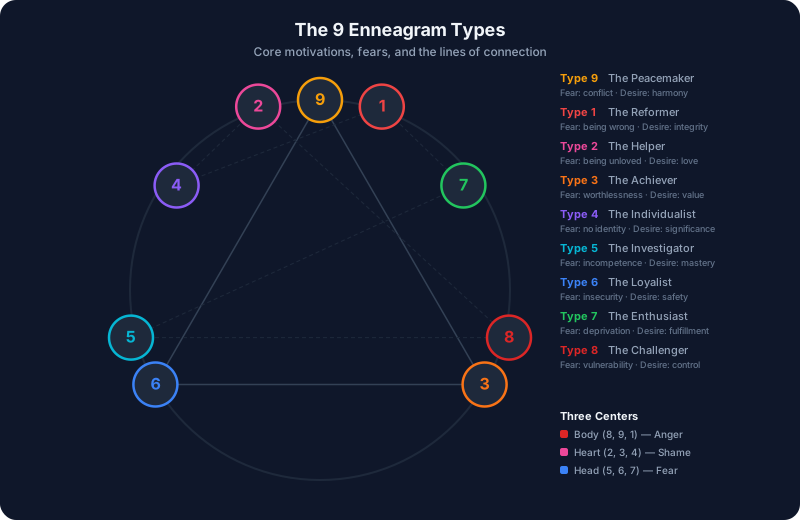
The Enneagram is a powerful personality framework that describes nine distinct patterns of thinking, feeling, and behaving. Unlike simpler personality models that focus on surface-level traits, the Enneagram digs into core motivations — the deep-seated fears and desires that drive human behavior. The word “Enneagram” comes from the Greek ennea (nine) and gramma (something written or drawn), referring to the nine-pointed geometric figure at the heart of the system.
The modern Enneagram draws from multiple traditions and was significantly developed by Oscar Ichazo and Claudio Naranjo in the 20th century. Today, it’s used widely in personal development, therapy, spiritual growth, and organizational leadership. The Enneagram Institute remains one of the most respected resources for in-depth type descriptions and research.
What makes the Enneagram uniquely valuable is that it doesn’t just describe what you do — it explains why you do it. Two people may exhibit the same behavior for entirely different reasons, and the Enneagram captures that distinction.
How the Enneagram Works
Each person has one dominant type that shapes their worldview, emotional habits, and default coping strategies. This type is believed to be established early in life and remains relatively stable, though healthy personal growth allows individuals to access the positive qualities of all nine types.
The nine types are organized into three Centers of Intelligence:
- Body Center (Types 8, 9, 1): These types lead with instinct and gut feelings. Their core emotional theme is anger.
- Heart Center (Types 2, 3, 4): These types lead with emotions and image. Their core emotional theme is shame.
- Head Center (Types 5, 6, 7): These types lead with thinking and analysis. Their core emotional theme is fear.
Understanding your center helps you recognize which intelligence you tend to rely on most — and which you might be neglecting.
The 9 Enneagram Types
Type 1: The Reformer
Core Motivation: To be good, ethical, and correct. Basic Fear: Being corrupt, defective, or morally flawed.
Ones are principled, purposeful, and self-controlled. They have a strong internal critic that constantly evaluates whether they and the world around them are meeting high standards. At their best, they are wise, discerning, and inspiring moral leaders. At their worst, they become rigid, judgmental, and self-righteous.
Growth Direction (→ Type 7): When Ones relax their inner critic, they access the spontaneity and joy of healthy Sevens. They learn to embrace imperfection and enjoy life more freely.
Stress Direction (→ Type 4): Under stress, Ones become moody, irrational, and self-pitying, taking on the unhealthy qualities of Fours.
Type 2: The Helper
Core Motivation: To be loved and needed by others. Basic Fear: Being unwanted or unworthy of love.
Twos are caring, generous, and people-pleasing. They have an extraordinary ability to sense what others need and often put others’ needs before their own. At their best, they are genuinely altruistic and nurturing. At their worst, they become manipulative and possessive, using their helpfulness as a way to control others.
Growth Direction (→ Type 4): Healthy growth leads Twos toward self-awareness and authenticity, embracing their own needs rather than only focusing on others.
Stress Direction (→ Type 8): Under stress, Twos become aggressive and domineering, demanding recognition for their sacrifices.
Type 3: The Achiever
Core Motivation: To be valuable, successful, and admired. Basic Fear: Being worthless or failing.
Threes are adaptive, ambitious, and image-conscious. They have a remarkable ability to set goals and achieve them, often excelling in competitive environments. At their best, they are authentic, inspiring role models. At their worst, they become deceptive and narcissistic, confusing their public image with their true self.
Growth Direction (→ Type 6): Growth leads Threes toward loyalty, commitment, and genuine connection with others rather than performance-based relationships.
Stress Direction (→ Type 9): Under stress, Threes become disengaged and apathetic, numbing themselves to avoid confronting feelings of failure.
Type 4: The Individualist
Core Motivation: To find their unique identity and express their authentic self. Basic Fear: Having no personal identity or significance.
Fours are sensitive, expressive, and deeply self-aware. They have an acute awareness of what’s missing in their lives and a longing for depth and meaning. At their best, they are profoundly creative and emotionally honest. At their worst, they become self-absorbed, melancholic, and envious of others.
Growth Direction (→ Type 1): Growth leads Fours toward objectivity and principled action, channeling their emotional depth into disciplined creative work.
Stress Direction (→ Type 2): Under stress, Fours become clingy and over-involved with others, seeking validation to offset their feelings of deficiency.
Type 5: The Investigator
Core Motivation: To be capable, competent, and knowledgeable. Basic Fear: Being helpless, useless, or overwhelmed.
Fives are perceptive, analytical, and private. They have an insatiable curiosity and a need to understand how the world works. At their best, they are visionary pioneers who make groundbreaking discoveries. At their worst, they become isolated, eccentric, and emotionally detached from reality.
Growth Direction (→ Type 8): Growth leads Fives toward confidence and decisive action, engaging with the world rather than merely observing it.
Stress Direction (→ Type 7): Under stress, Fives become scattered and hyperactive, seeking stimulation to avoid their feelings of emptiness.
Type 6: The Loyalist
Core Motivation: To have security, support, and guidance. Basic Fear: Being without support or unable to survive on their own.
Sixes are committed, responsible, and security-oriented. They are excellent at anticipating problems and preparing for worst-case scenarios. At their best, they are courageous, loyal, and self-reliant. At their worst, they become anxious, suspicious, and reactive, driven by catastrophic thinking.
Growth Direction (→ Type 9): Growth leads Sixes toward inner peace and trust, learning to relax their vigilance and accept uncertainty.
Stress Direction (→ Type 3): Under stress, Sixes become competitive and arrogant, projecting confidence to mask their inner anxiety.
Type 7: The Enthusiast
Core Motivation: To be satisfied, fulfilled, and free from pain. Basic Fear: Being deprived, trapped, or in pain.
Sevens are enthusiastic, versatile, and spontaneous. They have a remarkable ability to see possibilities and maintain an optimistic outlook. At their best, they are joyful, grateful, and deeply present. At their worst, they become impulsive, undisciplined, and addictive, constantly chasing the next experience to avoid negative emotions.
Growth Direction (→ Type 5): Growth leads Sevens toward depth and focus, learning to stay with experiences rather than constantly seeking new ones.
Stress Direction (→ Type 1): Under stress, Sevens become critical and perfectionist, turning their frustration outward in rigid judgments.
Type 8: The Challenger
Core Motivation: To protect themselves and control their environment. Basic Fear: Being harmed, controlled, or violated by others.
Eights are powerful, assertive, and confrontational. They have a natural leadership quality and an instinct to protect the vulnerable. At their best, they are magnanimous, heroic, and deeply caring. At their worst, they become domineering, intimidating, and ruthless.
Growth Direction (→ Type 2): Growth leads Eights toward vulnerability and compassion, learning to open their hearts and care for others without needing to control them.
Stress Direction (→ Type 5): Under stress, Eights become secretive and withdrawn, retreating into isolation rather than engaging with others.
Type 9: The Peacemaker
Core Motivation: To maintain inner peace and harmony. Basic Fear: Loss, fragmentation, and conflict.
Nines are accepting, trusting, and stable. They have a remarkable ability to see multiple perspectives and mediate conflicts. At their best, they are dynamic, self-aware peacemakers who bring people together. At their worst, they become passive, stubborn, and self-neglecting, merging with others’ agendas to avoid conflict.
Growth Direction (→ Type 3): Growth leads Nines toward self-development and purposeful action, discovering their own desires and pursuing them with energy.
Stress Direction (→ Type 6): Under stress, Nines become anxious and worried, seeking external reassurance as their inner peace crumbles.
Understanding Wings
Each Enneagram type is influenced by one or both of its neighboring types on the Enneagram circle. These neighboring types are called wings. For example, a Type 4 can have a Three-wing (4w3) or a Five-wing (4w5), and each wing adds a distinct flavor to the core type.
- 4w3 (The Aristocrat): More ambitious, image-conscious, and socially engaged than a 4w5
- 4w5 (The Bohemian): More introspective, unconventional, and intellectually curious than a 4w3
Most people lean toward one wing more than the other, though the strength of the wing influence varies from person to person. Your wing doesn’t change your core type — it simply adds nuance and complexity to your personality profile.
Understanding wings is essential for getting an accurate picture of your Enneagram type. Two people of the same core type with different wings can look and behave quite differently in daily life.
Using the Enneagram for Growth
The Enneagram is not meant to put you in a box — it’s meant to show you the box you’re already in so you can step out of it. Here are practical ways to use this knowledge:
- Recognize your patterns: Notice when your core fear is driving your behavior rather than conscious choice.
- Embrace your growth direction: Intentionally develop the healthy qualities of your growth type.
- Watch for stress reactions: Learn to catch yourself sliding into your stress direction and use it as a signal to practice self-care.
- Develop empathy: Understanding all nine types helps you appreciate why other people think and act differently than you do.
- Explore your wings: Experiment with leaning into both wings to develop a more well-rounded personality.
The Enneagram Institute offers extensive resources including detailed type descriptions, relationship compatibility guides, and personal growth recommendations for each type. Their Riso-Hudson Enneagram Type Indicator (RHETI) is one of the most scientifically validated Enneagram assessments available.
Final Thoughts
The Enneagram is a lifelong tool for self-understanding. Unlike personality tests that simply label you, the Enneagram invites ongoing reflection and growth. Your type doesn’t limit you — it reveals the specific path of development that will be most transformative for you.
Whether you’re trying to improve your relationships, advance your career, or simply understand yourself at a deeper level, knowing your Enneagram type gives you a clear map for the journey ahead. Take our Enneagram test to discover your type and begin exploring the rich landscape of your inner world.