What Is Reaction Time?
Reaction time is the interval between a stimulus appearing and your body responding to it. It sounds simple, but it involves a surprisingly complex chain of events: your sensory organs detect something, send a signal to your brain, your brain processes the information and decides on a response, then sends a motor command to your muscles.
All of that happens in fractions of a second. For a visual stimulus — like a light turning green — average human reaction time is approximately 200–250 milliseconds (0.2–0.25 seconds).
Reaction time isn’t a single thing. Researchers distinguish between:
- Simple reaction time: One stimulus, one response (a light turns on → press the button)
- Choice reaction time: Multiple stimuli with different required responses (which of four lights → which of four buttons)
- Complex reaction time: Involves decision-making and judgment rather than pre-planned responses
Simple reaction time is the baseline measured in most online tests. Choice and complex reaction times are better indicators of real-world cognitive performance because they involve processing and decision-making.
Average Reaction Times by Age
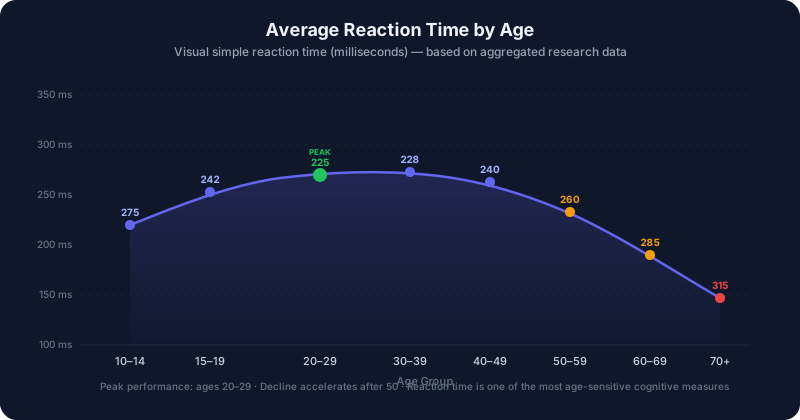
Reaction time follows a predictable arc through life. It improves rapidly in childhood, peaks in young adulthood, then gradually declines.
| Age Group | Average Simple Reaction Time |
|---|---|
| Children (8–12) | 350–600 ms |
| Teenagers (13–17) | 260–340 ms |
| Young adults (18–30) | 190–240 ms |
| Middle adults (31–50) | 220–280 ms |
| Older adults (51–65) | 280–350 ms |
| Seniors (65+) | 350–500 ms |
These are population averages with wide individual variation. Athletes, gamers, and people who do regular cognitive training consistently score better than sedentary peers in the same age group.
Fun comparison: A Formula 1 driver’s reaction time at race starts is typically 0.2–0.3 seconds — at the extreme edge of human performance under conditions of total focus. A blink takes about 0.15 seconds.
What Reaction Time Actually Predicts
Reaction time is a useful proxy for several aspects of cognitive function:
Processing Speed
The core cognitive ability measured is processing speed — how quickly your brain takes in information and acts on it. This same ability underlies other motor skills like typing speed, where fast processing translates directly into faster keystrokes. Processing speed declines with age and is one of the cognitive measures most sensitive to brain health, fatigue, and certain neurological conditions.
Early Cognitive Decline Detection
A 2024 study published in npj Aging monitored reaction times in older adults over two years. People without cognitive concerns showed consistent, predictable reaction times. Those experiencing subjective cognitive decline showed much higher variability and no consistent improvement trend. The researchers concluded that tracking reaction time over time could serve as a non-invasive, convenient screening tool for early cognitive impairment.
Attention and ADHD
Research with over 1,000 children found that reaction time variability — not just average speed — was specifically associated with inattention symptoms. Children with ADHD-related inattention showed more erratic reaction times than their peers, even when their average speed was similar. This suggests reaction time variability may be as informative as the average itself.
Athletic Performance
For athletes, reaction time directly impacts performance. A sprinter who reacts 50ms faster at the starting gun, a goalkeeper responding to a penalty kick, a tennis player reading a serve — these are all situations where milliseconds matter. Research consistently shows that sport-specific training improves reaction time in that context, though the benefits don’t always transfer broadly to other domains.
The Biggest Factors That Affect Your Reaction Time
Sleep Quality and Quantity
Sleep is the single biggest modifiable factor. A 2025 study found that sleep quality was positively correlated with reaction time (r = .37) — people with worse sleep showed meaningfully slower reactions. Even partial sleep deprivation (sleeping 6 instead of 8 hours) measurably slows reaction time and impairs decision-making.
The effect accumulates. Five nights of slightly reduced sleep creates a reaction time deficit comparable to being awake for 24 hours straight.
Cognitive Fatigue
Mental fatigue from sustained concentration slows reactions in a similar way to physical fatigue. A 2025 study found a significant correlation between cognitive fatigue and reaction time (r = .41). If you’ve been staring at a screen doing demanding work for hours, your reaction time will be noticeably slower than it was in the morning.
This is why professional esports players and athletes pay serious attention to cognitive recovery, not just physical recovery.
Caffeine
Caffeine modestly but reliably improves reaction time, particularly when you’re tired or sleep-deprived. The effect is larger when compensating for fatigue than when you’re already alert. Peak effect typically occurs 45–60 minutes after consumption.
Age
As noted above, reaction time naturally slows with age. The mechanism isn’t fully understood, but it involves reduced nerve conduction speed, changes in neurotransmitter systems, and decreased processing speed in the prefrontal cortex. Regular exercise appears to partially offset age-related decline.
Warm-Up
Like a car engine in cold weather, your brain performs better after warming up. If you take a reaction time test immediately after waking up, you’ll score worse than if you take it after being awake and active for an hour.
Practice and Anticipation
Repeated exposure to the same type of stimulus improves reaction time to that specific stimulus. This is partly why athletes show improved reaction times in their sport — they’ve rehearsed the response thousands of times. However, some of that “improvement” is actually anticipation (predicting when the stimulus will occur), not genuine processing speed.
Can You Improve Your Reaction Time?
Yes, within limits. Some aspects of reaction time are genetically determined and age-related. But meaningful improvement is possible:
Physical Exercise
Regular aerobic exercise is the most well-supported intervention for improving reaction time across the lifespan. A 2025 randomized controlled trial found that an 8-week balance-based visual exercise program produced measurable improvements in reaction time in older adults. The mechanism likely involves improved cerebrovascular health and neurotransmitter function.
Even single sessions of moderate exercise produce temporary reaction time improvements lasting hours.
Cognitive Training
Mobile app-based cognitive training has shown promise. A 2025 Frontiers in Psychology trial found that auditory reaction time was significantly improved (moderate effect size) in older adults using a cognitive training game, compared to a control group.
The key caveat: training on specific tasks improves performance on similar tasks more than it transfers broadly. “Brain training games” tend to improve your score on brain training games more than they improve general cognition.
Video Games
Action video games have the strongest and most replicated evidence for transferable reaction time improvements. Fast-paced games — first-person shooters, real-time strategy — require rapid responses to unpredictable stimuli, which trains the processing pathway in a generalizable way.
Regular action gamers consistently show faster reaction times than non-gamers in novel reaction time tasks, suggesting the benefit does transfer beyond the game itself.
Sleep
Optimizing your sleep is the most effective, accessible, and cost-free intervention for maintaining good reaction time over time. Consistently sleeping 7–9 hours per night produces better outcomes than any training protocol can compensate for.
Understanding Your Test Results
When you take a reaction time test online:
- Under 200ms: Very fast — athletic, well-rested, or experienced with this type of test
- 200–250ms: Above average for most adults
- 250–300ms: Average range for healthy adults
- 300–400ms: Below average; worth considering sleep, fatigue, or caffeine levels
- Above 400ms: Considerably slower than average — check if you’re very tired, distracted, or took the test upon waking
Results vary between sessions. Testing conditions (time of day, fatigue level, familiarity with the test format) can swing your result by 50–100ms. A single test is a snapshot, not a definitive measure. Testing multiple times and averaging is more informative than any individual result.
Also worth noting: the difference between a 200ms and 250ms reaction time is 50ms — that’s 0.05 seconds. In most everyday situations, this difference is irrelevant. Where it matters is in sport, driving, and high-speed activities where sustained performance under variable conditions is required.