What is Color Blindness?
Color blindness — more accurately called color vision deficiency (CVD) — is a condition where a person’s ability to distinguish certain colors is reduced. Despite its name, complete inability to see any color is extremely rare. Most people with color blindness can see colors, but they perceive a narrower range and may confuse specific color pairs that appear clearly distinct to people with normal color vision.
According to the National Eye Institute (NEI), color vision deficiency affects approximately 1 in 12 men (8%) and 1 in 200 women (0.5%) of Northern European descent worldwide. That means in a classroom of 30 students, statistically at least one boy is likely to have some form of color vision deficiency.
Understanding the types, causes, and impacts of color blindness is important — whether you suspect you have it, want to design accessible content, or simply want to learn how human vision works.
How Color Vision Works
To understand color blindness, you first need to understand normal color vision. The human retina contains two types of photoreceptor cells: rods (which handle low-light vision) and cones (which handle color and detail).
There are three types of cone cells, each sensitive to a different range of light wavelengths:
- L-cones (Long wavelength): Most sensitive to red light
- M-cones (Medium wavelength): Most sensitive to green light
- S-cones (Short wavelength): Most sensitive to blue light
Normal color vision — called trichromacy — relies on all three cone types functioning correctly. Your brain combines the signals from all three cone types to produce the full spectrum of colors you perceive. When one or more cone types are absent or malfunctioning, color vision deficiency results.
Red-Green Color Blindness
Red-green color blindness is by far the most common type, accounting for roughly 99% of all color vision deficiency cases. It occurs when either the L-cones (red) or M-cones (green) are absent or defective. The American Academy of Ophthalmology (AAO) classifies red-green CVD into four subtypes.
Protanopia (Red-Blind)
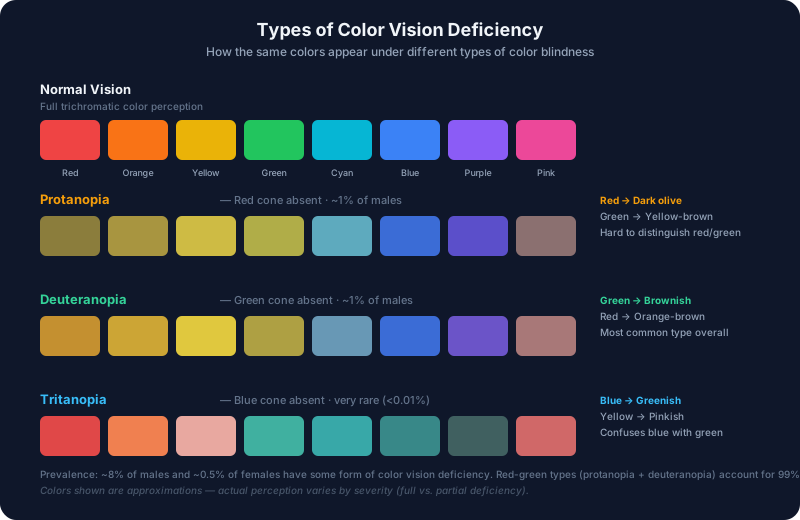
Protanopia is the complete absence of L-cone (red) photoreceptors. People with protanopia cannot perceive red light at all. Reds appear dark and muddy, often looking like dark brown or black. Orange and green may appear similar, and purple can look like blue because the red component is invisible.
Protanopia affects approximately 1% of males. Because the red cone is completely absent, there is also a brightness shift — red objects appear darker than they would to someone with normal vision, which can be a safety concern with red traffic lights or warning signals.
Protanomaly (Red-Weak)
Protanomaly is a milder form where L-cones are present but have a shifted sensitivity — they respond more like M-cones. This makes reds appear weaker, less vivid, and shifted toward green. People with protanomaly can often distinguish some reds from greens, but may struggle in low light or when colors are desaturated.
Protanomaly affects about 1% of males and is generally considered a mild to moderate deficiency. Many people with protanomaly are unaware of their condition until formally tested.
Deuteranopia (Green-Blind)
Deuteranopia is the complete absence of M-cone (green) photoreceptors. It is the most common form of color blindness, affecting about 1% of males. People with deuteranopia confuse greens and reds in ways similar to protanopia, but without the brightness reduction that protanopia causes.
For someone with deuteranopia, green traffic lights may appear pale or whitish, and distinguishing between green and brown, or red and brown, can be difficult. Unlike protanopia, red objects retain their normal brightness.
Deuteranomaly (Green-Weak)
Deuteranomaly is the most common type of color vision deficiency overall, affecting approximately 5% of males. The M-cones are present but have shifted sensitivity, making them respond more like L-cones. Greens appear more reddish, and it can be hard to tell the difference between certain shades of green, yellow, and red.
Most people with deuteranomaly have a mild form and may not realize they see colors differently. They can typically function well in daily life but may have difficulty with tasks like identifying ripe fruit, reading color-coded charts, or matching clothing.
Blue-Yellow Color Blindness
Blue-yellow color blindness is much rarer than red-green types, affecting roughly 1 in 10,000 people. It involves the S-cones (short wavelength / blue).
Tritanopia (Blue-Blind)
Tritanopia is the complete absence of S-cone (blue) photoreceptors. People with tritanopia cannot distinguish between blue and green, or between yellow and violet. Blues may appear greenish, and yellows can look pinkish or light gray. This type is extremely rare.
Unlike red-green color blindness, tritanopia is not X-linked — it is caused by a mutation on chromosome 7 and affects males and females equally.
Tritanomaly (Blue-Weak)
Tritanomaly is a reduced sensitivity of S-cones. Blues appear greener and it can be hard to tell yellow from red, or blue from green. This is an exceptionally rare condition. People with tritanomaly typically have difficulty distinguishing between blue and green shades and between yellow and red shades.
Complete Color Blindness
Achromatopsia (Rod Monochromacy)
Achromatopsia is total color blindness — a complete inability to see any color. It occurs when all three cone types are absent or nonfunctional, leaving only rod cells for vision. People with achromatopsia see the world entirely in shades of gray.
According to the National Eye Institute, achromatopsia affects roughly 1 in 33,000 people. In addition to the complete loss of color, people with this condition often experience:
- Extreme light sensitivity (photophobia): Rod cells are designed for low light, so normal daylight can be painfully bright
- Reduced visual acuity: Detail vision is significantly impaired, often around 20/200
- Nystagmus: Involuntary rapid eye movements
Achromatopsia is typically present from birth and is inherited as an autosomal recessive trait — both parents must carry the gene.
Blue Cone Monochromacy
A related but distinct condition, blue cone monochromacy occurs when both L-cones and M-cones are absent, leaving only S-cones and rods. Color vision is extremely limited, and symptoms are similar to achromatopsia but slightly less severe.
Genetics and Inheritance
The majority of color blindness is inherited and present from birth. The genes for L-cone and M-cone photopigments are located on the X chromosome, which is why red-green color blindness follows an X-linked recessive inheritance pattern.
- Males have one X chromosome (XY): A single defective gene on the X chromosome will cause color blindness because there is no second X to compensate.
- Females have two X chromosomes (XX): A defective gene on one X is usually compensated by a normal gene on the other X, making the female a carrier but not color blind.
This explains the dramatic difference in prevalence: approximately 8% of males are affected compared to only 0.5% of females. For a female to be color blind, she must inherit the defective gene from both parents — her father must be color blind and her mother must be at least a carrier.
The American Academy of Ophthalmology notes that color vision deficiency can also be acquired later in life through:
- Aging: Gradual decline in color discrimination
- Medications: Certain drugs can affect color perception
- Disease: Conditions like glaucoma, macular degeneration, Alzheimer’s, diabetes, and multiple sclerosis
- Chemical exposure: Industrial chemicals like carbon disulfide and styrene
- Eye injury: Damage to the retina or optic nerve
How Common Is Color Blindness, Really?
The scale of color vision deficiency is often underestimated. Over 350 million people worldwide have some form of CVD — roughly the population of the United States. Breaking this down:
- In the United States, approximately 12 million Americans (about 3.7% of the population) are color blind
- India has the highest absolute number globally — around 70 million people with CVD
- The Arab population has an unusually high rate: 10% of males affected, compared to the global male average of 8%
- Among the subtypes, deuteranomaly (weak green cones) is the most common, affecting about 2.32% of the total population
One striking fact from research: approximately 40% of color blind students leave school unaware they are color blind. They’ve adapted so well — or the condition is mild enough — that they never realized they were seeing colors differently from their classmates.
Daily Life Impact
The real-world impact of color blindness is broader than most people realize — and survey data makes it concrete:
The numbers: Among people with deuteranopia or protanopia (dichromats — missing a cone type entirely), 86% report difficulties with color-related everyday tasks. Among anomalous trichromats (weak but present cones), the figure is still 66%. These are not hypothetical inconveniences — they’re regular, recurring challenges.
Food and cooking: About 30% of people with abnormal color vision report difficulty judging the ripeness of fruit. Telling whether meat is fully cooked, identifying ripe avocados, or distinguishing fresh from off produce by color is genuinely harder.
Education: Color-coded materials in schools can be inaccessible. A map of Europe with neighboring countries in similar colors, a science diagram distinguishing red and green structures, a graph where data series are only differentiated by red versus green — these are common obstacles.
Career restrictions: Jobs including police officers, firefighters, airline pilots, maritime officers, and some military roles require normal color vision. Discovering color blindness after committing to a career path — particularly if it disqualifies you from your intended profession — can have significant emotional consequences.
Technology and data: User interfaces that rely solely on color coding (status indicators, chart series, error/success states) can be inaccessible. This is why WCAG accessibility guidelines require that information conveyed by color must also be available through text or pattern. Despite these guidelines, many digital products still fail this standard.
Safety: Difficulty distinguishing red and green can affect traffic signals, warning lights, and emergency signage. Most people with CVD learn to interpret signals by position (top = stop, bottom = go) rather than color — a practical adaptation, but one that only works when signals are in standard positions.
How to Test for Color Blindness
Several testing methods are used to diagnose and classify color vision deficiency:
Ishihara Test: The most widely used screening test. It consists of plates with colored dots forming numbers or patterns. People with normal vision see one number; people with CVD see a different number or none at all. It effectively screens for red-green deficiency but does not test for blue-yellow types.
Cambridge Colour Test: A more precise computer-based test that can identify the type and severity of color vision deficiency.
Anomaloscope: Considered the gold standard for diagnosing red-green CVD. The person adjusts a mixture of red and green light to match a yellow reference. How they set the match reveals the type and degree of deficiency.
Farnsworth-Munsell 100 Hue Test: The person arranges colored caps in order by hue. Errors reveal the type and severity of CVD. It is particularly useful for detecting blue-yellow deficiencies and subtle anomalies.
If you suspect you may have color vision deficiency, a comprehensive eye examination with a qualified ophthalmologist or optometrist is recommended. The NEI recommends children be screened for color vision problems before starting school, as early identification helps teachers accommodate the child’s needs.
Living with Color Blindness
While there is currently no cure for inherited color blindness, several tools and strategies can help:
- Color-identifying apps: Smartphone apps can identify colors through the camera in real time
- EnChroma and similar lenses: Special glasses that may enhance color discrimination for some types of red-green CVD, though results vary and they do not restore normal vision
- Labeling and organization: Systematic labeling of clothing, use of color-identifier tools for daily tasks
- Accessibility advocacy: Requesting color-accessible materials in education and the workplace
Gene therapy research is ongoing, with promising results in animal models. According to the National Eye Institute, clinical trials are exploring potential treatments, though widespread availability is likely still years away.
Conclusion
Color blindness encompasses a spectrum of conditions from mild color weakness to total absence of color perception. The vast majority of cases involve red-green deficiency, inherited through the X chromosome, which is why it overwhelmingly affects males. Understanding the specific type of CVD — whether protanopia, deuteranomaly, tritanopia, or another variant — matters for appropriate accommodation and, increasingly, for potential future treatments.
If you think you or your child may have a color vision deficiency, start with a screening test and follow up with a comprehensive eye exam. Early identification leads to better adaptation and ensures access to tools and accommodations that make daily life easier.